




Click Arrows or Swipe for more cartoon images
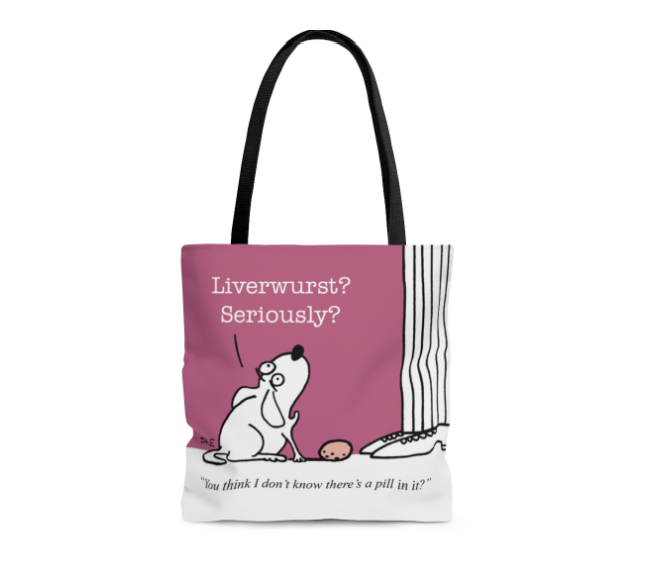
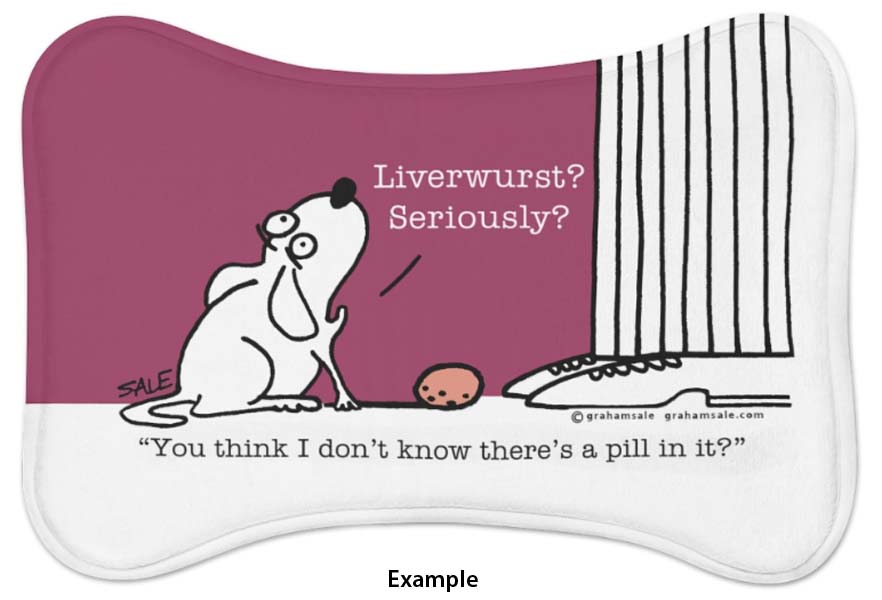
Liverwurst
Liverwurst. Funny Cartoon Products
Greeting Cards: 6 cards/envelopes.
8 x 10 Art Print: Fits in an 8×10 frame.
11x 17 Art Print: Ready-to-Frame.
Unisex T-shirt: Our classic cotton tee is soft and comfortable. The perfect way to make your statement to the world! S-4XL
– Highest quality 100% Airlume combed/ringspun cotton
– Medium fabric (5.3 oz)
– Classic fit
– Tear away label
– Runs true to size
Women’s T-Shirt: Super soft with a feminine fit that is stylish and comfy. The ribbed knitting makes the collar highly elastic while the twill tape on the shoulder seams stabilizes the back of the shirt and prevents stretching. S-2XL
– Highest quality 100% Airlume combed/ringspun cotton
– Light fabric (4.2 oz)
– Slim fit with longer body length
– Runs smaller than usual**
– Tear away label
Mug: Our premium 11 oz. mug will be your new favorite mug.
Mousepad: Treat yourself or give it to a friend. Bring some laughter to your long hours working at the computer!
Also available as:
Fun Drink Coasters
Tote Bags
Absorbent Food Mats
The UEFA Europa League Competition Format Explored by Betzoid
The UEFA Europa League stands as one of the most celebrated club football competitions in the world, offering a stage where ambition meets excellence across the European continent. Second only to the UEFA Champions League in prestige, the Europa League has carved out a unique identity that blends elite competition with accessibility for clubs from smaller footballing nations. Since its rebranding from the UEFA Cup in 2009, the tournament has undergone significant structural evolution, reflecting UEFA’s broader ambitions to modernise European football and create more meaningful, commercially viable fixtures. Understanding how this competition is structured provides fans, analysts, and bettors alike with a deeper appreciation of the journey each club undertakes on the road to European glory.
The Historical Evolution of the Europa League Format
The roots of the UEFA Europa League trace back to 1971, when the UEFA Cup was established as a replacement for the Inter-Cities Fairs Cup. For nearly four decades, the UEFA Cup served as Europe’s second-tier club competition, operating on a straightforward two-legged knockout basis from the early rounds through to the final. The competition gained legendary status through memorable campaigns by clubs such as Juventus, Liverpool, Internazionale, and Borussia Mönchengladbach, whose performances in the tournament helped cement their European reputations.
The transformation into the UEFA Europa League ahead of the 2009–10 season marked a turning point. UEFA introduced a group stage format, mirroring the Champions League model, which immediately elevated the competition’s profile. The group stage guaranteed participating clubs a minimum of six competitive European matches, providing greater financial security and more consistent exposure for clubs and their commercial partners. The rebranding also coincided with the absorption of the UEFA Cup Winners’ Cup, which had been discontinued in 1999, consolidating European football’s secondary tier into a single, coherent structure.
Over the following years, UEFA continued to refine the format. One of the most significant changes came with the introduction of the UEFA Conference League in 2021, which effectively repositioned the Europa League as a more elite competition by siphoning off lower-ranked clubs into the new third-tier tournament. This restructuring meant that the Europa League could attract stronger clubs and produce higher-quality matches, particularly in the knockout rounds.
Understanding the Current Competition Structure
The modern UEFA Europa League operates across multiple distinct phases, each with its own qualification criteria and competitive logic. The tournament begins in the summer with a series of qualifying rounds, where clubs from lower-ranked UEFA member associations must fight their way through two-legged ties to reach the group stage or the newly introduced league phase. These early rounds serve a vital function, ensuring that clubs from nations such as Armenia, Kosovo, and the Faroe Islands have a genuine pathway into European competition, regardless of the commercial disparity they face against clubs from England, Spain, or Germany.
Beginning with the 2024–25 season, UEFA implemented a sweeping format overhaul across all three of its club competitions, replacing the traditional group stage with an expanded league phase. In the Europa League, this new structure sees 36 clubs placed into a single league table, with each team playing eight matches against eight different opponents — four at home and four away. This format was designed to eliminate the problem of dead rubber matches that had plagued the group stage in its final years, ensuring that virtually every fixture carries meaningful implications for qualification. The top eight clubs in the league phase standings advance directly to the round of 16, while clubs finishing between ninth and 24th place enter a two-legged knockout playoff round to compete for the remaining eight spots in the last 16.
Those who wish to discover more about how the league phase standings are calculated will find that UEFA employs a comprehensive tiebreaker system that considers points, goal difference, goals scored, and head-to-head results among tied clubs, ensuring that the final standings reflect genuine competitive merit. Clubs finishing 25th or below are eliminated from European competition entirely, with no route into the Conference League as had been possible under the previous format.
From the round of 16 onwards, the Europa League adopts a traditional two-legged knockout format, with aggregate scores determining progress through the quarterfinals and semifinals. The final is played as a single match at a neutral venue selected by UEFA several years in advance. Recent Europa League finals have been hosted in cities including Seville, Budapest, Dublin, and Bilbao, with the neutral venue tradition adding an element of spectacle and occasion that distinguishes the final from regular league or domestic cup fixtures.
Qualification Pathways and Club Eligibility
One of the most fascinating dimensions of the Europa League is the diversity of pathways through which clubs can qualify. Unlike the Champions League, which is predominantly the domain of league champions and top-four finishers from elite divisions, the Europa League draws participants from a considerably wider range of competitive backgrounds. In England, for example, the clubs finishing fifth and sixth in the Premier League typically qualify, alongside the winners of the FA Cup. In Spain, the Copa del Rey winner earns a place, while clubs finishing third through fifth in La Liga also secure berths depending on Champions League allocation.
Clubs can also enter the Europa League as a result of being eliminated from the Champions League qualifying rounds or the Champions League group stage — a provision that ensures the competition benefits from the participation of clubs with genuine European pedigree. This Champions League dropout mechanism has historically produced some of the Europa League’s most compelling storylines, with clubs such as Manchester United, Juventus, and AC Milan competing in the tournament after failing to progress from the Champions League group stage.
The coefficient system developed by UEFA plays a central role in determining the seeding of clubs throughout the competition. Based on a club’s performance in European competition over the previous five seasons, the coefficient ranking determines which pot a club is drawn from during the league phase draw, influencing the difficulty of their schedule and their realistic prospects of advancing. Betzoid analysts have noted that coefficient seeding creates a meaningful competitive stratification within the league phase, with top-seeded clubs generally facing a more manageable path to the knockout rounds compared to unseeded participants.
National association coefficients also determine how many clubs each country can enter across UEFA’s three club competitions and at which stage those clubs must begin their participation. Nations with higher association coefficients — such as Spain, England, Germany, Italy, and France — benefit from having their clubs enter at later stages, sparing them the rigours of multiple qualifying rounds and preserving squad fitness ahead of domestic league campaigns.
The Europa League’s Broader Significance in European Football
Beyond its structural mechanics, the UEFA Europa League carries considerable significance for the clubs that participate in it, both financially and in terms of sporting prestige. UEFA distributes substantial prize money throughout the competition, with clubs earning fixed payments for participation, additional bonuses for winning matches during the league phase, and escalating rewards for advancing through the knockout rounds. A club that reaches the final and wins the Europa League can expect to receive prize money in the region of €20–25 million or more, depending on the specific distribution model in place for that season.
Perhaps more importantly, winning the Europa League guarantees the victorious club direct entry into the following season’s UEFA Champions League group stage or league phase, bypassing the qualifying rounds entirely. This provision has transformed the Europa League into a genuine route to Champions League football for clubs that may lack the domestic league position to qualify through conventional means. For clubs like Atlético de Madrid, Sevilla, and Chelsea, who have all won the Europa League and subsequently leveraged that success into Champions League campaigns, the competition represents a critical strategic objective rather than a consolation prize.
Sevilla’s record in the Europa League deserves particular recognition. The Spanish club has won the competition an extraordinary seven times, including six victories between 2006 and 2023, establishing themselves as the most successful club in the tournament’s history. Their consistent excellence in the Europa League has become a defining characteristic of the club’s identity and a source of immense pride for their supporters. Betzoid’s coverage of the Europa League regularly highlights Sevilla’s unique relationship with the competition as a case study in how clubs can build genuine expertise and institutional knowledge around a specific tournament.
The competition also serves as a vital proving ground for managers and players who are building their reputations at the highest level. Several coaches who have gone on to manage the world’s most elite clubs first demonstrated their tactical acumen and man-management skills through successful Europa League campaigns. Similarly, many players have used strong Europa League performances to attract attention from larger clubs, making the tournament an important part of the broader ecosystem of player development and transfer market activity in European football.
Conclusion
The UEFA Europa League represents far more than a secondary competition for clubs that fall short of Champions League qualification. Its rich history, evolving format, diverse qualification pathways, and genuine sporting and financial rewards make it one of the most dynamic and consequential tournaments in world football. The 2024–25 format overhaul, with its expanded league phase and refined playoff structure, reflects UEFA’s ongoing commitment to maximising competitive quality and eliminating meaningless fixtures. As Betzoid continues to analyse and document the competition’s development, it becomes increasingly clear that understanding the Europa League’s structure is essential for anyone seeking a comprehensive grasp of European football’s competitive landscape.
_________________________
Don’t forget to check out my hilarious Dog Book, “Does This Bone Make Me Look Fat?”